Female Net Worth chartfor Professional Adults 43 years old
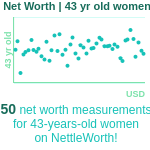
Average Net Worth for 43 year old women
For most 43 year old women in America, Net Worth measurements fall between $86,642 and $618,869. The median Net Worth for women in this age group is $247,548, according to the Federal Reserve's 2022 Survey of Consumer Finances and anonymized data from users.All Results
Enter your Net Worth measurements above to see how they compare
So far, we have recorded 0 Net Worth measurements for 43 year old women on NettleWorth!
(chart updates daily)
Chart Insights
At 43, is your net worth growing at a pace that reflects both your earning power and your long-term financial strategy? The median net worth for 43-year-old women stands at $247,500, with most women in this group holding between $86,600 at the 25th percentile and $618,900 at the 75th percentile. The spread between the 25th and 75th percentile is wide at this age, reflecting just how different financial outcomes can be among women who entered their forties with very different wealth foundations and earning trajectories. The average net worth for this group is notably higher than the median at $495,000, elevated by a small number of women with exceptional wealth - large inherited estates, extraordinary long-term investment returns, or the proceeds of significant business ownership - whose financial circumstances are simply not representative of the financial reality most women are navigating at 43. NettleWorth uses the median because it is the most honest and practically useful benchmark available: the precise midpoint where exactly half of your peers hold more and half hold less, so you are measuring yourself against the genuine financial landscape of women your age.
Milestones and Peer Comparisons
At 43, most women are in or approaching their peak earnings and experiencing meaningful net worth acceleration. For women who navigated career interruptions in their thirties, the forties offer an opportunity to close the gap through higher income, reduced family expenses, and maximized retirement contributions. The catch-up contribution available at 50 ($8,000 additional to a 401(k) annually) is a powerful tool approaching fast. A net worth around $247,500 is typical at 43; above $618,900 puts you firmly on track for a financially secure and independent retirement. Having a net worth around $247,500 places you right at the median for 43-year-old women, while a net worth above $618,900 puts you in the top quarter of your age group.
Tips and Growth Factors
At 43, you are in the phase where consistent financial decisions produce the most visible acceleration in net worth. Maximize retirement contributions and plan to take full advantage of the $8,000 catch-up contribution available at 50, which adds an additional $48,000 or more to your retirement savings over the six years before 56. Women live an average of 5-6 years longer than men, which means your retirement portfolio needs to sustain income for a longer period - this should be reflected in a savings rate and investment strategy that accounts for a retirement potentially lasting 30+ years. Consider whether your asset allocation is appropriately aggressive for the long runway ahead: a woman at 43 with a 30-year retirement horizon can typically afford more equity exposure than conventional wisdom suggests.
Data Sources and Methodology
All statistics on this page are derived from reputable sources, including the Federal Reserve's Survey of Consumer Finances, anonymized data from NettleWorth users, and our own research.
Net worth percentiles presented on this page are generated using a robust, age-based modeling framework designed to reflect realistic patterns of wealth accumulation throughout the lifespan. The approach applies a double exponential smoothing technique, calibrated to match Federal Reserve Survey of Consumer Finances data. Our data spans the earning and retirement life stages from adolescence through late retirement. We use a range of separate percentiles (from the 2nd to the 99th) that are calculated for every age and demographic group, with demographic adjustments built into the model to reflect currently observed population-level trends.
Primary data sources include the Federal Reserve's Survey of Consumer Finances (2022 release), Distributional Financial Accounts, IRS Personal Wealth Statistics, and leading financial research from the Federal Reserve, IRS, and Vanguard. Net worth figures are specified for U.S. residents in USD and follow the original percentile structure used in our calculations.
Further details on our assumptions and our transparent methodology are described in our documentation for those seeking deeper insight into the modeling process and its limitations. Get in touch to discuss further or if you believe an error has been made somewhere.
See more ages