Household Annual Income chartfor Young Adults 20 years old
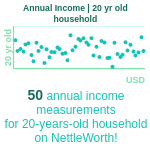
Average Annual Income for 20 year old households
For most 20 year old households in America, Annual Income measurements fall between $18,215 and $43,716. The median Annual Income for households in this age group is $30,358, according to the Federal Reserve's 2022 Survey of Consumer Finances and anonymized data from users.All Results
Enter your Annual Income measurements above to see how they compare
So far, we have recorded 0 Annual Income measurements for 20 year old households on NettleWorth!
(chart updates daily)
Chart Insights
At 20, are you starting to understand how your early earning decisions will shape the income trajectory of the next two decades? The median annual income for 20-year-old households stands at $44,000, with most households in this group earning between $21,120 at the 25th percentile and $77,000 at the 75th percentile. At this stage, income is typically from part-time work, summer employment, or the early stages of a first full-time role - highly variable and still ramping up. Household income reflects the combined earnings of all income earners in the household, giving dual-income households a significant advantage over single-income households at every age bracket. The average income is higher than the median at $63,800, pulled upward by high earners in the top decile whose incomes are not representative of the typical experience. NettleWorth uses the median as its primary benchmark because it gives you the most accurate picture of where most households your age actually stand.
Milestones and Peer Comparisons
At 20, most households have at least one member beginning to earn meaningful income. Even modest combined household income at this stage can be deployed powerfully by establishing joint savings habits, building an emergency fund together, and starting retirement contributions as early as possible. Earning around $44,000 places your household at the median for 20-year-old households, while an income above $77,000 puts your household in the top quarter of your household's age group.
Tips and Growth Factors
At 20, the most important income-related financial actions are those that protect and grow your future earning power. Investing in skills and credentials - whether through education, certifications, or on-the-job experience - is the highest-return investment available at this age. Save 15-20% of every paycheck before spending the rest: the discipline of paying yourself first, established early, becomes automatic by the time you reach the higher-income years where it matters most. Avoid lifestyle inflation with each income increase: the gap between what you earn and what you spend is the engine of all wealth building.
Data Sources and Methodology
All statistics on this page are derived from reputable sources, including the Federal Reserve's Survey of Consumer Finances, anonymized data from NettleWorth users, and our own research.
Annual income percentiles presented on this page are generated using a robust, age-based modeling framework calibrated to reflect realistic patterns of income growth, peak earning, and post-retirement income across the lifespan. The approach applies smoothing techniques aligned with Bureau of Labor Statistics and Census Bureau income data. We use a range of separate percentiles (from the 2nd to the 99th) that are calculated for every age and demographic group, with demographic adjustments built into the model to reflect currently observed population-level trends.
Primary data sources include the U.S. Bureau of Labor Statistics Current Population Survey (2024), U.S. Census Bureau Current Population Survey Annual Social and Economic Supplement (2024), the Federal Reserve's Survey of Consumer Finances (2022 release), and the Social Security Administration wage index data. Income figures are specified for U.S. residents in USD as gross pre-tax annual income.
Further details on our assumptions and our transparent methodology are described in our documentation for those seeking deeper insight into the modeling process and its limitations. Get in touch to discuss further or if you believe an error has been made somewhere.
See more ages