Household Net Worth chartfor Young Professionals 25 years old
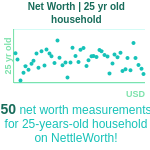
Average Net Worth for 25 year old households
For most 25 year old households in America, Net Worth measurements fall between $2,695 and $19,250. The median Net Worth for households in this age group is $7,700, according to the Federal Reserve's 2022 Survey of Consumer Finances and anonymized data from users.All Results
Enter your Net Worth measurements above to see how they compare
So far, we have recorded 0 Net Worth measurements for 25 year old households on NettleWorth!
(chart updates daily)
Chart Insights
Has your household's combined financial momentum caught up with the ambitions you shared at the start? The median net worth for 25-year-old households stands at $7,700, with most households in this group holding between $2,700 at the 25th percentile and $19,300 at the 75th percentile. The spread between the 25th and 75th percentile at this age is relatively wide, reflecting how differently financial paths diverge during the twenties based on career trajectory, debt levels, and early savings habits. The average net worth is considerably higher than the median at $15,400, driven by a relatively small number of exceptionally wealthy households whose financial circumstances - large inherited estates, successful business sales, or decades of high-income accumulation - are not representative of where most 25-year-old households actually stand. NettleWorth uses the median to give your household the most honest and grounded benchmark available: the exact midpoint where half of your peer households hold more and half hold less, without distortion from outliers whose reality has no bearing on yours.
Milestones and Peer Comparisons
At 25, many households are in the phase of maximum financial momentum - two careers developing simultaneously, combined incomes rising, and the compounding of early savings beginning to accelerate. Many are homeowners or are actively saving toward a down payment, and the coordination of two retirement accounts creates savings velocity that single-income households cannot match. A combined household net worth around $7,700 at 25 represents solid progress; reaching $19,300 or beyond puts your household firmly on track for financial independence by the late forties or early fifties. Having a net worth around $7,700 places your household right at the median for 25-year-old households, while a net worth above $19,300 puts your household in the top quarter of your household's age group.
Tips and Growth Factors
At 25, most households are approaching or have reached the phase where dual income becomes the most powerful wealth-building engine available. The priority is maximizing that advantage: both partners contributing to retirement accounts, ideally at 15% or more of combined income including any employer match, building a six-month emergency fund to absorb financial shocks without going into debt, and making deliberate decisions about housing that prioritize equity-building over status. Avoiding lifestyle inflation as incomes rise is critical - a household that maintains spending at 65-70% of combined income and invests the remainder can reach financial independence a decade earlier than one that allows spending to grow with every raise. If homeownership is a goal, protecting your down payment savings in a high-yield savings account while building credit scores to above 740 ensures you qualify for the best available mortgage rates when the time comes.
Data Sources and Methodology
All statistics on this page are derived from reputable sources, including the Federal Reserve's Survey of Consumer Finances, anonymized data from NettleWorth users, and our own research.
Net worth percentiles presented on this page are generated using a robust, age-based modeling framework designed to reflect realistic patterns of wealth accumulation throughout the lifespan. The approach applies a double exponential smoothing technique, calibrated to match Federal Reserve Survey of Consumer Finances data. Our data spans the earning and retirement life stages from adolescence through late retirement. We use a range of separate percentiles (from the 2nd to the 99th) that are calculated for every age and demographic group, with demographic adjustments built into the model to reflect currently observed population-level trends.
Primary data sources include the Federal Reserve's Survey of Consumer Finances (2022 release), Distributional Financial Accounts, IRS Personal Wealth Statistics, and leading financial research from the Federal Reserve, IRS, and Vanguard. Net worth figures are specified for U.S. residents in USD and follow the original percentile structure used in our calculations.
Further details on our assumptions and our transparent methodology are described in our documentation for those seeking deeper insight into the modeling process and its limitations. Get in touch to discuss further or if you believe an error has been made somewhere.
See more ages