Ménage Patrimoine net graphiquepour Jeunes professionnels 26 ans
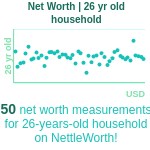
Moyenne Patrimoine net pour 26 ans ménages
Pour la plupart des 26 ans ménages en Amérique, les mesures Patrimoine net se situent entre 3 355 $US et 23 966 $US. La médiane Patrimoine net pour ménages dans ce groupe d'âge est 9 587 $US, selon l'enquête de 2022 sur les finances des consommateurs de la Réserve fédérale et les données anonymisées des utilisateurs de .Tous les résultats
Saisissez ci-dessus les mensurations de votre Patrimoine net pour comparer les résultats
Jusqu'à présent, nous avons enregistré 0 Patrimoine net mesures pour 26 ans ménages sur NettleWorth !
(le graphique est mis à jour quotidiennement)
Informations sur le graphique
Le momentum financier combiné de votre ménage a-t-il rattrapé les ambitions que vous avez partagées au début ? La valeur nette médiane des ménages de 26 ans s'élève à 9 600 $, la plupart des ménages de ce groupe ayant une valeur comprise entre 3 400 $ au 25e percentile et 24 000 $ au 75e percentile. L'écart entre le 25e et le 75e percentile à cet âge est relativement large, reflétant la manière dont les parcours financiers divergent de manière différente pendant la vingtaine en fonction de la trajectoire de carrière, des niveaux d'endettement et des habitudes d'épargne précoces. La valeur nette moyenne est considérablement plus élevée que la médiane à 19 200 $, tirée par un nombre relativement restreint de ménages exceptionnellement riches dont les circonstances financières - grandes successions héritées, ventes d'entreprises prospères ou décennies d'accumulation de revenus élevés - ne sont pas représentatives de la situation de la plupart des ménages de 26 ans. NettleWorth utilise la médiane pour offrir à votre ménage le repère le plus honnête et basé : le point médian exact où la moitié de vos ménages pairs détient plus et l'autre moitié détient moins, sans distorsion provenant d'exceptionnels dont la réalité n'a aucune incidence sur la vôtre.
Jalons et Comparaisons entre Pairs
À 26 ans, de nombreux ménages sont dans la phase de maximum de momentum financier - deux carrières se développant simultanément, des revenus combinés en hausse, et la capitalisation des économies précoces commençant à accélérer. Beaucoup sont propriétaires ou épargnent activement pour un apport, et la coordination de deux comptes de retraite crée une vélocité d'épargne que les ménages à revenu unique ne peuvent égaler. Une valeur nette combinée d'environ 9 600 $ à 26 ans représente des progrès solides ; atteindre 24 000 $ ou plus met votre ménage fermement sur la voie de l'indépendance financière d'ici la fin de la quarantaine ou le début de la cinquantaine. Avoir une valeur nette d'environ 9 600 $ place votre ménage exactement à la médiane pour les ménages de 26 ans, tandis qu'une valeur nette supérieure à 24 000 $ place votre ménage dans le quart supérieur de votre tranche d'âge.
Conseils et Facteurs de Croissance
À 26 ans, la plupart des ménages approchent ou ont atteint la phase où le revenu double devient le moteur le plus puissant de construction de richesse disponible. La priorité est de maximiser cet avantage : les deux partenaires contribuant aux comptes de retraite, idéalement à 15 % ou plus du revenu combiné, y compris toute contribution de l'employeur, constitution d'un fonds d'urgence de six mois pour absorber les chocs financiers sans tomber dans l'endettement, et prendre des décisions délibérées concernant le logement qui privilégient la constitution de capital plutôt que le statut. Éviter l'inflation du style de vie à mesure que les revenus augmentent est crucial - un ménage qui maintient ses dépenses à 65-70 % du revenu combiné et investit le reste peut atteindre l'indépendance financière une décennie plus tôt que celui qui permet aux dépenses d'augmenter avec chaque augmentation de salaire. Si l'accession à la propriété est un objectif, protéger vos économies pour l'apport dans un compte d'épargne à rendement élevé tout en améliorant les scores de crédit au-dessus de 740 garantit que vous serez éligible aux meilleurs taux d'intérêt hypothécaires disponibles lorsque le moment sera venu.
Sources de Données et Méthodologie
Toutes les statistiques de cette page proviennent de sources réputées, y compris l'enquête sur les finances des consommateurs de la Réserve fédérale, des données anonymisées des utilisateurs de NettleWorth, et notre propre recherche.
Les percentiles de valeur nette présentés sur cette page sont générés en utilisant un cadre de modélisation robuste, basé sur l'âge, conçu pour refléter des schémas réalistes d'accumulation de richesse tout au long de la vie. L'approche applique une technique de lissage exponentiel double, calibrée pour correspondre aux données de l'enquête sur les finances des consommateurs de la Réserve fédérale. Nos données couvrent les étapes de vie professionnelles et de retraite, de l'adolescence jusqu'à la retraite tardive. Nous utilisons une gamme de percentiles distincts (du 2e au 99e) qui sont calculés pour chaque groupe d'âge et démographique, avec des ajustements démographiques intégrés dans le modèle pour refléter les tendances observées au niveau de la population.
Les principales sources de données comprennent l'enquête sur les finances des consommateurs de la Réserve fédérale (version 2022), les Comptes financiers distributionnels, les Statistiques de richesse personnelle de l'IRS, et les recherches financières de premier plan de la Réserve fédérale, de l'IRS et de Vanguard. Les chiffres de valeur nette sont spécifiés pour les résidents américains en USD et suivent la structure de percentile d'origine utilisée dans nos calculs.
Des détails supplémentaires sur nos hypothèses et notre méthodologie transparente sont décrits dans notre documentation pour ceux qui recherchent une compréhension plus approfondie du processus de modélisation et de ses limitations. Contactez-nous pour en discuter davantage ou si vous pensez qu'une erreur a été commise quelque part.
Voir d'autres tranches d'âge