Male Retirement Fund chartfor Retirees 65 years old
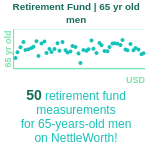
Average Retirement Fund for 65 year old men
For most 65 year old men in America, Retirement Fund measurements fall between USD 108,771 and USD 621,550. The median Retirement Fund for men in this age group is USD 310,775, according to the Federal Reserve's 2022 Survey of Consumer Finances and anonymised data from users.All Results
Enter your Retirement Fund measurements above to see how they compare
So far, we have recorded 0 Retirement Fund measurements for 65 year old men on NettleWorth!
(chart updates daily)
Chart Insights
At 65, is your retirement fund being managed and distributed in a way that sustains your income needs for the full length of retirement? The median retirement fund balance for 65-year-old men stands at $283,400, with most men in this group holding between $99,190 at the 25th percentile and $651,820 at the 75th percentile. Men typically accumulate higher retirement balances than women at the same age, reflecting a combination of historically higher wages, fewer career interruptions, and longer average tenure in employment. The Federal Reserve's Survey of Consumer Finances shows a household median retirement savings of $200,000 for the 65-74 age group, reflecting the combined value of 401(k)s, IRAs, and other retirement accounts for those who have them. The average retirement fund balance is considerably higher than the median at approximately $793,520, driven by a small number of high earners and long-term savers whose balances are not representative of the typical experience. NettleWorth uses the median because it reflects where most men your age actually stand, not a figure inflated by outliers at the top of the distribution.
Milestones and Peer Comparisons
At 65, your retirement fund is in active distribution mode, providing income alongside Social Security and any other retirement income sources. A balance around $283,400 is typical for this age group; those above $651,820 have substantial retirement reserves. Required minimum distributions apply to traditional 401(k)s and IRAs beginning at 73 (under SECURE 2.0), mandating annual minimum withdrawals that count as taxable income regardless of whether the funds are needed. Managing the tax implications of RMDs alongside Social Security and other income sources is one of the most consequential financial planning tasks in early retirement. Having a retirement fund around $283,400 places you at the median for 65-year-old men, while a balance above $651,820 puts you in the top quarter of your age group.
Tips and Growth Factors
At 65, the priority is sustaining your retirement fund through smart withdrawal strategy and ongoing investment management. The 4% rule - withdrawing no more than 4% of your portfolio's value annually - has historically provided portfolio longevity across 30-year retirement periods. Coordinate withdrawals across different account types (taxable, traditional, Roth) to minimise annual tax liability. Required minimum distributions from traditional accounts at 73+ must be managed alongside other income sources to avoid unnecessary tax exposure. Ensure your asset allocation balances growth (equities to beat inflation) with stability (bonds and cash to absorb volatility): a 50-60% equity allocation is appropriate for most men at 65 with a potentially long retirement horizon.
Data Sources and Methodology
All statistics on this page are derived from reputable sources, including the Federal Reserve's Survey of Consumer Finances, anonymised data from NettleWorth users, and our own research.
Retirement fund percentiles presented on this page are generated using a robust, age-based modelling framework calibrated to reflect realistic patterns of retirement savings accumulation and drawdown throughout the lifespan. The approach applies smoothing techniques calibrated to align with Federal Reserve Survey of Consumer Finances data and Vanguard participant data. We use a range of separate percentiles (from the 2nd to the 99th) that are calculated for every age and demographic group, with demographic adjustments built into the model to reflect currently observed population-level trends.
Primary data sources include the Federal Reserve's Survey of Consumer Finances (2022 release), Vanguard's How America Saves (2025 edition), Fidelity Investments Q4 2024 retirement analysis, and the Investment Company Institute Fact Book. Retirement fund figures are specified for U.S. residents in USD and follow the percentile structure used in our calculations.
Further details on our assumptions and our transparent methodology are described in our documentation for those seeking deeper insight into the modelling process and its limitations. Get in touch to discuss further or if you believe an error has been made somewhere.
See more ages