Household Annual Income chartfor Retirees 66 years old
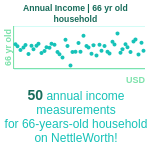
Average Annual Income for 66 year old households
For most 66 year old households in America, Annual Income measurements fall between $44,886 and $107,727. The median Annual Income for households in this age group is $74,811, according to the Federal Reserve's 2022 Survey of Consumer Finances and anonymized data from users.All Results
Enter your Annual Income measurements above to see how they compare
So far, we have recorded 0 Annual Income measurements for 66 year old households on NettleWorth!
(chart updates daily)
Chart Insights
At 66, does your retirement income structure - from Social Security, withdrawals, and other sources - give you the financial security and flexibility you planned for? The median annual income for 66-year-old households stands at $58,000, with most households in this group earning between $27,840 at the 25th percentile and $101,500 at the 75th percentile. At this stage, reported income reflects a mix of continued employment income for those still working, Social Security benefits, pension payments, and investment distributions - making the definition of annual income more varied than in the working years. Household income reflects the combined earnings of all income earners in the household, giving dual-income households a significant advantage over single-income households at every age bracket. The average income is higher than the median at $84,100, pulled upward by high earners in the top decile whose incomes are not representative of the typical experience. NettleWorth uses the median as its primary benchmark because it gives you the most accurate picture of where most households your age actually stand.
Milestones and Peer Comparisons
At 66, household income typically reflects a mix of Social Security benefits for both household members, retirement account distributions, pension income where applicable, and possibly some continuing employment. A household income around $58,000 is typical; the coordinated management of all income sources to minimize taxes and maximize longevity is the most important ongoing financial management task in retirement. Earning around $58,000 places your household at the median for 66-year-old households, while an income above $101,500 puts your household in the top quarter of your household's age group.
Tips and Growth Factors
At 66, retirement income management is the central financial task. Coordinate your income sources - Social Security, required minimum distributions, pension payments, and any continuing employment income - to minimize annual tax liability while meeting spending needs. Review your withdrawal strategy annually against your actual spending and portfolio performance. Social Security benefits increase with inflation (COLA) annually, which is one of the most valuable inflation hedges in retirement income. Ensure your estate plan reflects how you want remaining income-producing assets to be managed and distributed.
Data Sources and Methodology
All statistics on this page are derived from reputable sources, including the Federal Reserve's Survey of Consumer Finances, anonymized data from NettleWorth users, and our own research.
Annual income percentiles presented on this page are generated using a robust, age-based modeling framework calibrated to reflect realistic patterns of income growth, peak earning, and post-retirement income across the lifespan. The approach applies smoothing techniques aligned with Bureau of Labor Statistics and Census Bureau income data. We use a range of separate percentiles (from the 2nd to the 99th) that are calculated for every age and demographic group, with demographic adjustments built into the model to reflect currently observed population-level trends.
Primary data sources include the U.S. Bureau of Labor Statistics Current Population Survey (2024), U.S. Census Bureau Current Population Survey Annual Social and Economic Supplement (2024), the Federal Reserve's Survey of Consumer Finances (2022 release), and the Social Security Administration wage index data. Income figures are specified for U.S. residents in USD as gross pre-tax annual income.
Further details on our assumptions and our transparent methodology are described in our documentation for those seeking deeper insight into the modeling process and its limitations. Get in touch to discuss further or if you believe an error has been made somewhere.
See more ages